


VISIT PRAGUE CASTLE
Prague Castle is much more than just a monument: it is a historic complex that encompasses over a thousand years of European history. It stands on Hradčany Hill, overlooking the Vltava River, and with its unmistakable silhouette it has become one of the symbols of the Czech nation. Founded around 880 by the Přemyslid prince Bořivoj, it covers an area of approximately 70,000 square metres and is considered the largest continuous castle complex in the world.
Visiting Prague Castle means walking through palaces, courtyards, churches, gardens and fortifications belonging to different periods. It is therefore much more than a simple walk among monuments: every corner of the complex preserves stories, legends, political events and secrets connected to the past of the city and of Europe.
The main entrance is located in Hradčany Square, where visitors are welcomed by the monumental Gate of the Giants. The large statues depict two giants engaged in combat and lead into the First Courtyard. This is also where the changing of the guard takes place every hour, one of the most ceremonial moments of the visit. This area, designed in the Neoclassical style by Niccolò Pacassi, architect to Maria Theresa of Austria, represents the elegant entrance to the most important institutional spaces of the complex. Prague Castle is still the official residence of the President of the Czech Republic today.
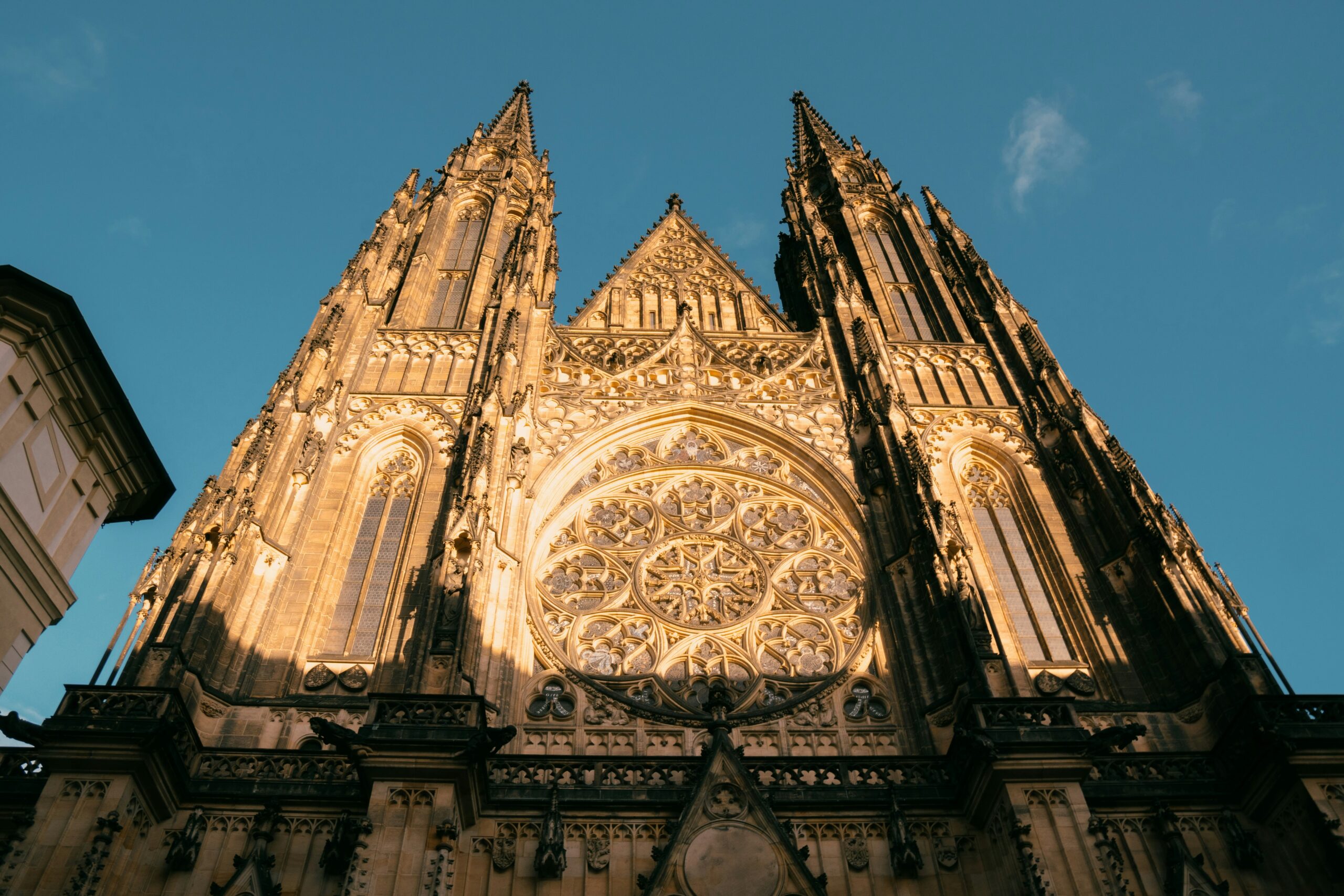
Beyond the Second Courtyard, the scene is dominated by the imposing vertical structure of the Cathedral of Saints Vitus, Wenceslas and Adalbert. Considered the spiritual heart of the castle, it is one of the most important masterpieces of European Gothic architecture. Its construction lasted for almost six centuries, from 1344 to 1929, which is why the building features elements belonging to different architectural styles.
Inside the cathedral, light passes through magnificent stained-glass windows, including one created by Art Nouveau master Alfons Mucha. One of the most fascinating spaces is the Chapel of St Wenceslas, decorated with semi-precious stones and frescoes depicting episodes from the saint’s life. Equally impressive is the monumental silver tomb of St John of Nepomuk. Those who wish to admire Prague from above can also climb the bell tower, which offers a spectacular view over the red rooftops of Malá Strana and Charles Bridge.
Next to the cathedral stands the Old Royal Palace, which until the 16th century served as the residence of the rulers of Bohemia. Its most famous room is Vladislav Hall, an extraordinary example of Late Gothic architecture. The ceiling is characterised by elaborate ribbed vaults that intertwine to form patterns resembling the petals of a flower carved in stone.
Vladislav Hall was so large that in the past it could even host indoor jousting tournaments. Knights could enter the hall directly on horseback through the distinctive Riders’ Staircase. Not far away is the Bohemian Chancellery, connected to one of the most important episodes in European history: the famous Defenestration of Prague in 1618. This event contributed to the outbreak of the Thirty Years’ War, which would profoundly change the balance of power in modern Europe.
Continuing eastward, the richness of Gothic architecture gives way to the more austere forms of St George’s Basilica. Easily recognisable by its red Baroque façade and two white stone towers, it is the oldest religious building in the complex to have survived to the present day in its original structure. The simple yet atmospheric interior preserves a Romanesque style that contrasts with the Baroque style of the adjoining chapel. Some of the earliest members of the Přemyslid dynasty are also buried in its crypts.
Among the unmissable stops at Prague Castle is the Golden Lane, a small street nestled within the fortress walls and lined with tiny, brightly coloured houses. The dwellings were originally built to house the king’s marksmen and today help create one of the most fairy-tale-like atmospheres in the entire complex.
According to legend, during the reign of Rudolf II, some of these houses were inhabited by alchemists searching for the secret of turning lead into gold. House number 22, recognisable by its distinctive blue façade, was instead used as a home and workplace by the writer Franz Kafka, who found inspiration in the dreamlike and labyrinthine atmosphere of this place. Today, several of the small houses contain historical reconstructions dedicated to the lives of former craftsmen, as well as small shops where visitors can find products such as crystal and traditional marionettes.
At the end of the Golden Lane stands Daliborka Tower, a former prison named after its first inmate, the knight Dalibor. Legend has it that during his imprisonment, Dalibor learned to play the violin.
The visit can continue through the Royal Gardens, from which Prague Castle and its fortifications can be admired from a different perspective. Designed according to Renaissance principles, they are home to Queen Anne’s Summer Palace, considered one of the most beautiful Renaissance palaces in Europe, and the historic Ball Game Hall. During spring and summer, these green spaces also offer a pleasant alternative to the more crowded areas of the complex.
Prague Castle can almost be considered a city within the city. One of the best times to visit is early in the morning, continuing your exploration until sunset, when the cathedral and the other buildings in the complex take on a particularly evocative atmosphere and seem to tower above Prague’s historic centre.
Visiting Prague Castle therefore means much more than admiring a series of monuments. It is a journey through centuries of history, architecture, legends, political events, moments of glory and tragedies that have helped shape one of the most fascinating capitals in the world.
What to See at Prague Castle
Prague Castle is one of the most important symbols of the Czech Republic and dominates the capital from the top of Hradčany Hill. Considered the largest ancient castle in the world, it encompasses almost a thousand years of architectural history, with buildings and interiors ranging from Romanesque to Baroque, as well as 20th-century additions.
St Vitus Cathedral, the Gothic heart of the castle
The spiritual and visual centre of the entire complex is St Vitus Cathedral, recognisable from different parts of the city thanks to its tall dark spires. Once inside, the light filtering through the large stained-glass windows creates a particularly evocative atmosphere.
Among the most famous stained-glass windows are those created by Art Nouveau master Alfons Mucha, whose style blends surprisingly well into the medieval setting. Also not to be missed is the Chapel of St Wenceslas, decorated with more than 1,300 semi-precious stones and frescoes dedicated to the life of the patron saint.
The choir also contains the monumental royal mausoleum in white marble, while some of the rulers of Bohemia are buried in the crypt below. The cathedral also houses the Crown Jewels, kept in a chamber protected by seven locks, whose keys are entrusted to various senior state officials.
The Old Royal Palace and Vladislav Hall
From the Third Courtyard, visitors can enter the Old Royal Palace, the residence of the princes and kings of Bohemia from the 9th to the 16th century. Its most spectacular room is Vladislav Hall, one of the great masterpieces of Late Gothic architecture.
The ceiling is characterised by elaborate ribbed vaults that form patterns resembling floral decorations. Thanks to its large size, the hall was used not only for coronations and banquets, but also for jousting tournaments. Knights could in fact enter directly on horseback via the Riders’ Staircase.
A small side door leads to the Bohemian Chancellery, the site of the famous Defenestration of Prague in 1618, an episode that contributed to the outbreak of the Thirty Years’ War and profoundly influenced European history.
St George’s Basilica and Convent
Not far from the cathedral stands the distinctive red façade of St George’s Basilica, considered one of the best-preserved Romanesque churches in the Czech Republic. Founded around 920, it offers a striking contrast to the Gothic grandeur of the nearby St Vitus Cathedral.
The interior is simple and austere, with light stone naves and an atmosphere that recalls the origins of Bohemian history. Some of the earliest dukes of Bohemia are buried in the crypts. Next to the basilica stands the convent of the same name, now used for important exhibitions of ancient art from the National Gallery.
Golden Lane: between alchemy and literature
Heading towards the eastern fortifications, you reach Golden Lane, one of the most picturesque areas of Prague Castle. The street is lined with small colourful houses, originally built in the 16th century to accommodate the castle guards.
According to tradition, during the reign of Rudolf II, some alchemists searching for gold and the Philosopher’s Stone are said to have lived here. Over the centuries, the houses were also occupied by craftsmen, people from the poorer classes and intellectuals.
Particularly famous is house number 22, recognisable by its blue façade, where Franz Kafka lived between 1916 and 1917. Away from the noise of the city, the writer found the peace and quiet he needed to work on some of his best-known short stories.
The towers and ancient prisons
The castle’s defensive system also preserves places of great interest. At the end of Golden Lane stands Daliborka Tower, a former prison named after its first inmate, Dalibor of Kozojedy.
According to legend, during his imprisonment Dalibor learned to play the violin so well that the people of Prague would gather beneath the walls to listen to him. Another structure connected to the castle’s function as a prison is the White Tower, where members of the nobility who had fallen from favour were also imprisoned and tortured.
The Royal Gardens and the Belvedere
If the visit takes place between April and October, it is also worth including the Royal Gardens. Located beyond the Deer Moat, these green spaces allow visitors to admire the castle and the city from different panoramic viewpoints.
Here stands Queen Anne’s Belvedere, considered one of the purest examples of Italian Renaissance architecture outside Italy. In the gardens, visitors can also see the distinctive Singing Fountain, so called because of the metallic and melodic sound produced by the water falling onto the bronze basins.
The Changing of the Guard
One of the most ceremonial moments of the visit takes place every day at 12:00 noon in the First Courtyard, near the main entrance overlooking Hradčany Square. The noon Changing of the Guard takes place in a solemn form, accompanied by fanfares and the exchange of flags.
The guards’ uniforms were designed by Theodor Pištěk, a costume designer who also worked on the film Amadeus, and they add a particularly theatrical touch to this institutional ceremony.
Visiting Prague Castle therefore means much more than simply walking through palaces and monuments. It is a journey through different eras, capable of telling centuries of history and conveying the feeling of being in one of the places that shaped Europe’s past.
COMBINE AND SAVE
Useful info
Opening hours
Prague Castle is open every day, but opening times vary depending on the areas you visit. The castle complex is generally open from 6:00 a.m. to 10:00 p.m., while the historic buildings can be visited from 9:00 a.m. to 5:00 p.m. in summer and until 4:00 p.m. in winter.
Location
Prague Castle is located in the Hradčany district, on a hill overlooking the Vltava River and Prague’s historic centre. Its official address is Hrad I. nádvoří 1, Hradčany, 119 08 Prague 1, Czech Republic.
How to get there
Allow at least 2 to 3 hours to visit the main attractions of Prague Castle, including St Vitus Cathedral, the Old Royal Palace, St George’s Basilica and Golden Lane. If you also want to explore the gardens, exhibitions and other areas at a relaxed pace, consider spending half a day at the complex.
Best time to visit
For a quieter visit to Prague Castle, choose the early morning hours, preferably on weekdays. Late afternoon can also be a good alternative, while the middle of the day tends to be busier, especially during the high season and holiday periods.
Duration of the visit
The easiest way to reach Prague Castle is by tram no. 22, getting off at the Pražský hrad stop. From there, it is about a 5-minute walk to the castle. Alternatively, take Metro Line A to Malostranská and walk up to the complex via the Old Castle Stairs.
Accessibility
Prague Castle is partially accessible to visitors with reduced mobility. The courtyards and several of the main historic buildings can be visited by wheelchair users, although cobblestones, slopes and steps can make some areas more difficult to access. The towers and some parts of Golden Lane are not fully accessible, and assistance may be required in certain areas.
Opening hours
Prague Castle is open every day, but opening times vary depending on the areas you visit. The castle complex is generally open from 6:00 a.m. to 10:00 p.m., while the historic buildings can be visited from 9:00 a.m. to 5:00 p.m. in summer and until 4:00 p.m. in winter.
Location
Prague Castle is located in the Hradčany district, on a hill overlooking the Vltava River and Prague’s historic centre. Its official address is Hrad I. nádvoří 1, Hradčany, 119 08 Prague 1, Czech Republic.
How to get there
Allow at least 2 to 3 hours to visit the main attractions of Prague Castle, including St Vitus Cathedral, the Old Royal Palace, St George’s Basilica and Golden Lane. If you also want to explore the gardens, exhibitions and other areas at a relaxed pace, consider spending half a day at the complex.
Best time to visit
For a quieter visit to Prague Castle, choose the early morning hours, preferably on weekdays. Late afternoon can also be a good alternative, while the middle of the day tends to be busier, especially during the high season and holiday periods.
Duration of the visit
The easiest way to reach Prague Castle is by tram no. 22, getting off at the Pražský hrad stop. From there, it is about a 5-minute walk to the castle. Alternatively, take Metro Line A to Malostranská and walk up to the complex via the Old Castle Stairs.
Accessibility
Prague Castle is partially accessible to visitors with reduced mobility. The courtyards and several of the main historic buildings can be visited by wheelchair users, although cobblestones, slopes and steps can make some areas more difficult to access. The towers and some parts of Golden Lane are not fully accessible, and assistance may be required in certain areas.
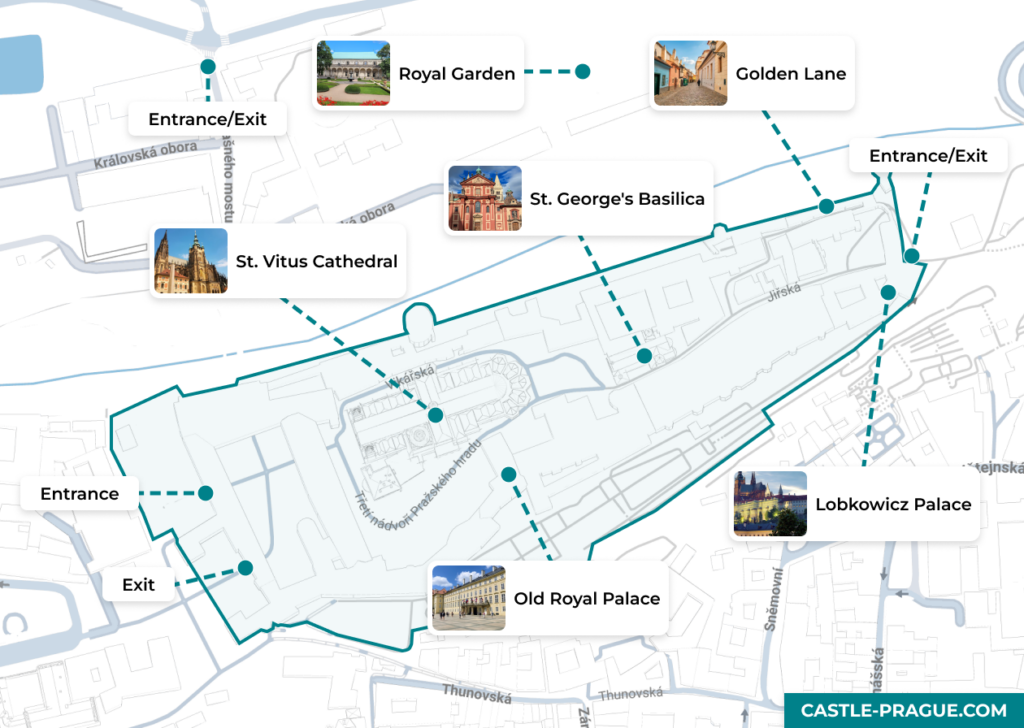
Prague Castle Map